 Jun 29, 2025
Debugging, Parenting, and Other High-Stakes Fire Drills
Parallels Between Code and Kids
| Debugging Tactic | Parenting Application |
|---|---|
| Check recent changes | "What did you eat before this tantrum?" |
| Isolate variables | "Is it the socks or the shoes bothering you?" |
| Roll back last deployment | "Let's go back to bedtime routine version 1.3" |
| Logs & Observability | Ask your partner, who was watching five minutes ago |
Parenting and production debugging have more overlap than I ever expected. Both involve unpredictable systems, unclear documentation, and stakeholders who will absolutely scream if you break something.
Critical Tools for Both
# Parenting Stack
1. Snack Break         # Equivalent to restarting the server
2. Distraction Tactic  # Like rolling back a deployment
3. Sleep Debugging     # Works on toddlers AND Kubernetes
4. Incident Report     # AKA "What did we learn from that LEGO mishap?"
"The only difference between a midnight diaper change and a PagerDuty alert? One lets you claim overtime."
When Both Worlds Collide
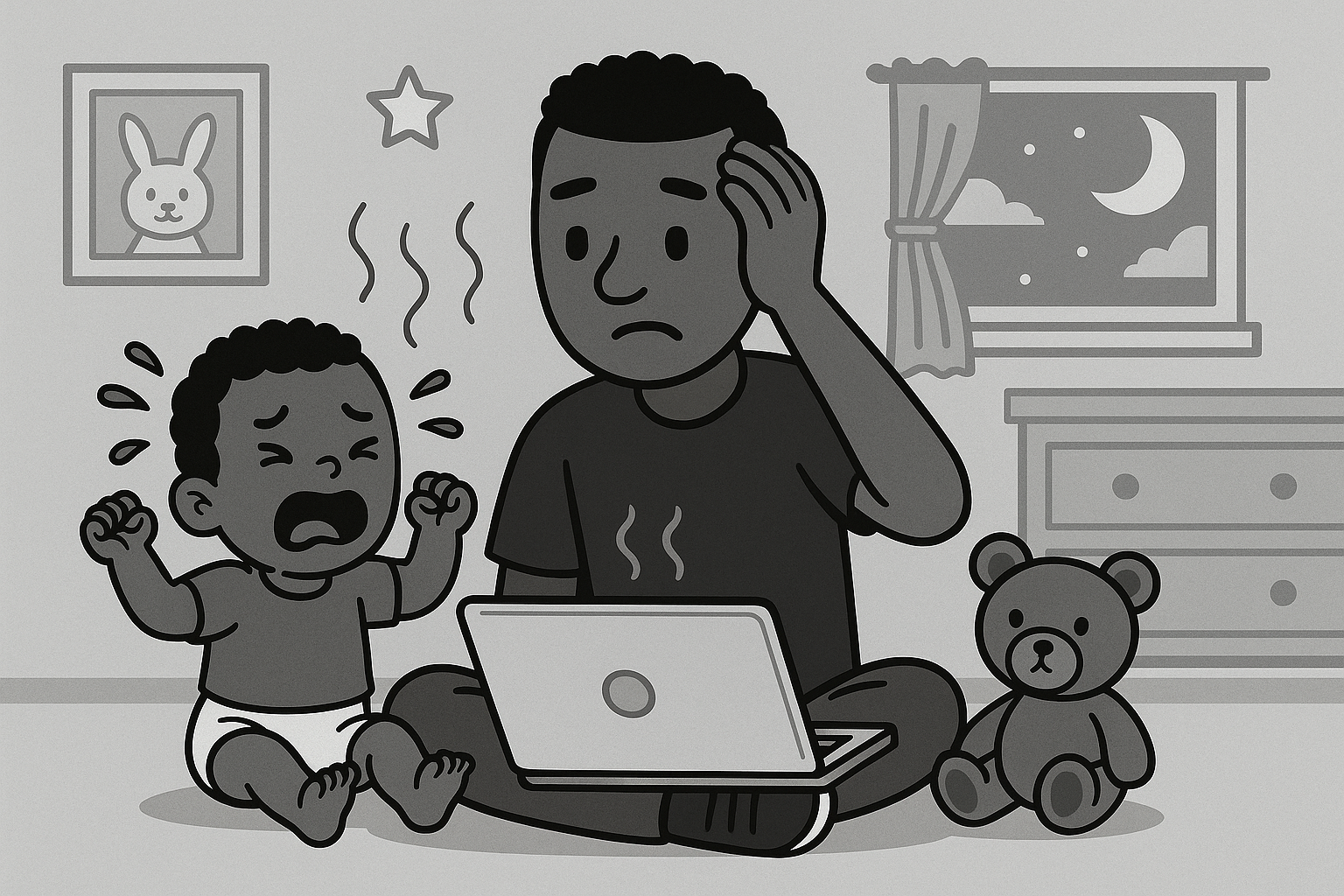
There was a night when the production API failed right as my daughter spilled applesauce on the TV remote. I had one hand on a laptop, the other wiping a sticky screen, and a toddler yelling, “WHY IS COCOMELON GONE?” It was the most stressful failover scenario I’ve ever managed.
That’s when it hit me: parenting trained me to stay calm under fire. It’s just that in one world the logs are JSON, and in the other, they're crayon drawings on the wall.
Incident Response IRL
When a production bug takes down a service, we rally, diagnose, and fix fast. But at home, the incident response might involve three rounds of negotiation, bribery via popsicles, and ultimately a forced restart (read: nap).
One of my kids once refused to wear anything but a superhero cape for a week. No shirt, no shoes—just the cape. After trying logic, persuasion, and pleading, I gave in and documented it as a Known Issue. Sometimes you don’t fix the bug—you just contain it and move on.
Systems Thinking Everywhere
As a dev, I think in inputs, outputs, and failure modes. Now I’ve started applying the same mindset to the bedtime routine:
- Inputs: Tooth brushing, story time, last sip of water
- Output: Asleep child
- Failure Modes: Too much sugar, scary story, missing blanket
I’ve literally created flowcharts for our morning routine. My spouse thinks I’m ridiculous. But we haven’t missed the school bus in six months.
What Parenting Has Taught Me About Tech (and Vice Versa)
- Don’t assume the problem is obvious—ask better questions.
- Clear communication matters more than clever solutions.
- Sometimes the fix isn’t elegant—it’s duct tape and a promise to revisit it next week.
- Resilience beats perfection. The system (or the child) will crash. Your job is to recover quickly and kindly.
My Favorite Multi-Domain Debugging Wins
- The Nighttime Downtime: When a toddler wakes up at 2am screaming, check: dry diaper, water level, blanket alignment. If all else fails, cuddle. (Analogous to restarting Redis.)
- The API Timeout: When a child stares blankly and doesn’t respond, assume buffer overload. Try gentle prompts. If no response, offer snack (or `curl -I localhost:snack`).
- The Pull Request Review: When a kid proudly shows you their block tower and it’s leaning like Pisa, say: “Nice start! Want to add support at the base?” Works every time.
Lessons & Reflections
- The best debugging isn’t about fixing fast—it’s about understanding deeply.
- Systems—whether digital or human—are messy, emotional, and non-linear.
- Patience, presence, and perspective are your best tools, whether you’re handling a 500 error or a five-year-old meltdown.
This post offered an unexpected lens into the topic of "Debugging, Parenting, and Other High-Stakes Fire Drills"—something I initially underestimated. What began as a routine story evolved into a surprisingly personal audit of where I’ve grown, where I’ve slipped, and what continues to challenge me. I realized that my path hasn't been about linear progress; it’s been a series of weird detours, punchline errors, and the occasional small win that gave me just enough momentum to keep going.
If there's a takeaway, it’s this: context matters. The same challenge that might’ve broken me five years ago now feels like a teachable moment. And maybe that’s the definition of growth. Thanks for sticking with the post—I hope your own journey is full of equally ridiculous, humbling, and surprisingly meaningful moments.